
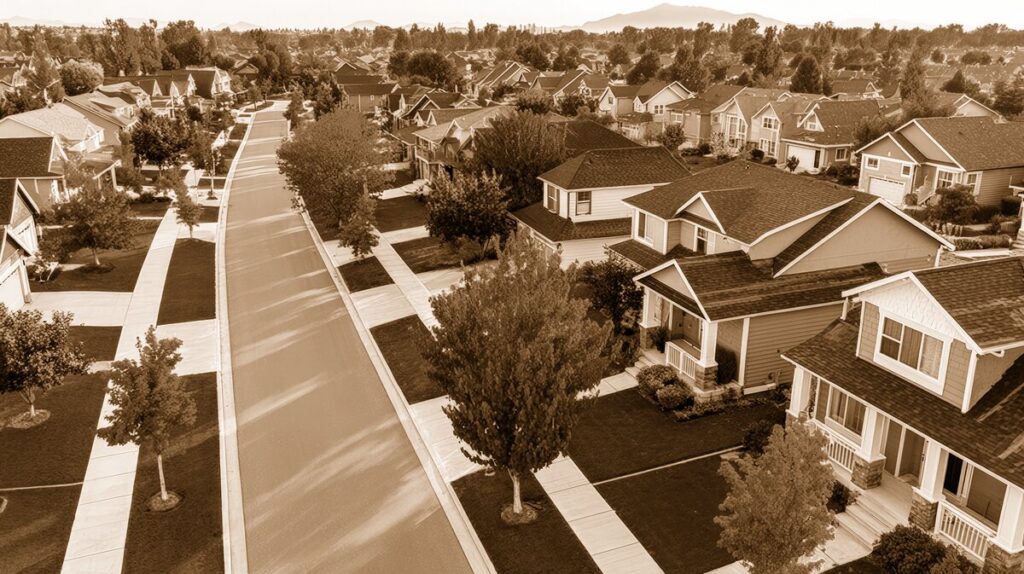
A Modern Neighborhood with Deep Local Roots
Brownstone is one of Avon’s newer residential neighborhoods, but its story is closely tied to the much older history of the community around it. Like many Avon subdivisions, Brownstone grew out of the town’s transition from a small rural settlement into one of Hendricks County’s most active suburban communities.
Today, Brownstone is known for its welcoming streets, shared green space, playground areas, and family-centered atmosphere. Public neighborhood information describes more than 17 acres of common area, including parks, a playground, and a gazebo. Those features give Brownstone a pleasant sense of place and help distinguish it from a simple collection of houses.
For longtime Avon residents, Brownstone represents a familiar pattern: farmland and open fields gradually becoming a neighborhood while remaining connected to the community’s older roads, schools, parks, and traditions.
How Brownstone Got Its Name
The name *Brownstone* sounds as though it might refer to a historic building, a local family, or an old quarry. However, publicly available town records do not identify a specific nineteenth-century building or family that gave the neighborhood its name.
Instead, Brownstone appears to be a modern subdivision name chosen during the community’s development. The name likely reflects the warm, sturdy image associated with brownstone architecture and urban townhomes. In a growing suburb, names such as Brownstone help create an identity for a new residential area, offering a feeling of permanence and character even when the homes are relatively recent.
That is part of Avon’s modern heritage. Many neighborhood names—Brownstone, Waterford Lakes, Austin Lakes, Wynne Farms, Timber Bend, and others—evoke landscapes, materials, or traditional community settings. Together, they tell the story of a town building new neighborhoods while preserving a sense of familiarity and belonging.
Avon Before Brownstone
To understand Brownstone, it helps to look at Avon before the subdivision was built. The community has passed through several names, including Hampton, White Lick, Smootsdell, and New Philadelphia, before becoming Avon. According to the Town of Avon, the name Avon became established after a railroad man placed a stake at the rail yard marked “Avon.”
That railroad connection was important. For generations, rail lines, farm roads, and routes such as present-day U.S. 36 and Avon Avenue shaped how people moved through the area. Farms, small businesses, churches, schools, and gathering places developed around those transportation corridors.
Avon incorporated as a town in 1995, a milestone that reflected its growing population and changing role in the Indianapolis metropolitan area. The town is located only a few miles west of Indianapolis and remains close to the Indianapolis International Airport, making it attractive to commuters and families seeking more space while staying connected to the city.
Brownstone belongs to this post-1995 chapter of Avon history—the period when former agricultural land began to make room for carefully planned residential neighborhoods, new schools, commercial centers, and expanded public services.
Key Milestones in Brownstone’s Development
Brownstone’s history is less about a single dramatic event than a series of steady changes.
- Neighborhood planning and construction: Brownstone was established as part of Avon’s continuing residential growth, with homes arranged around shared open space and community amenities.
- Expansion through sections: Property records identify Brownstone sections, showing that the neighborhood developed in stages rather than appearing all at once. A Hendricks County property record, for example, references Brownstone Section 3.
- Town recognition: Brownstone appears on Avon’s official lists of neighborhoods and subdivisions, including the town’s rezoning and snow-removal documents.
- Connection to Avon schools: Neighborhood information associates Brownstone with Maple Elementary, Avon Intermediate School–East, Avon Middle School–North, and Avon High School.
- Growing civic infrastructure: As Avon expanded, road improvements, trails, parks, and public facilities helped connect newer neighborhoods with the broader town.
These milestones reflect the everyday work of building a community: laying streets, establishing common areas, welcoming first homeowners, and creating routines that eventually become neighborhood traditions.
Streets, Green Space, and Nearby Landmarks
Brownstone’s identity comes primarily from its residential setting and shared amenities. The parks, playground, and gazebo provide natural gathering places for residents, particularly families with children. In a neighborhood where many homes were built during the same general period, these common areas help create visual variety and encourage neighbors to meet outside their homes.
The neighborhood is also part of a larger Avon network shaped by roads such as U.S. 36, Avon Avenue, and Ronald Reagan Parkway. These routes connect Brownstone residents to shopping, restaurants, schools, medical services, and employment centers throughout Avon and the west side of Indianapolis.
Nearby public spaces add another layer to the neighborhood’s sense of place. Avon’s park system includes Blue Heron Park—formerly Town Hall Park—as well as Washington Township Park, Gable Park, Winton Meadows Park, Reagan Woods, and Pecar Park. Town Hall Park, now Blue Heron Park, includes walking paths, water features, playgrounds, fishing areas, and memorials. Washington Township Park hosts community events such as the Avon Community Heritage Festival.
These parks are not historic landmarks in the traditional sense, but they are important landmarks in the lives of modern Avon families. They are where residents attend festivals, watch children play, walk after dinner, and encounter neighbors from across town.
Schools and Community Life
Schools have always been central to Avon’s identity. The community’s educational tradition reaches back to the early days of local one-room schools and township education. Today, Avon Community School Corporation is one of the institutions that gives newer neighborhoods like Brownstone a shared civic connection.
The Avon-Washington Township Library also plays an important role in preserving local memory. The Town of Avon and the library have worked together on oral-history projects covering former residents, transportation, schools, businesses, and community landmarks. Those projects remind us that history is not limited to old buildings. It is also found in personal stories, family photographs, school memories, and the recollections of people who watched fields become neighborhoods.
For Brownstone residents, community life is often built through smaller moments: children riding bikes to the playground, neighbors gathering near the gazebo, seasonal decorations appearing along the streets, and families heading together to a school event or park festival.
Brownstone’s Place in Avon’s Future
Brownstone has evolved from a new subdivision into an established part of Avon’s residential landscape. Its homes, shared spaces, and neighborhood routines now form a recognizable chapter in the town’s ongoing story.
What makes Brownstone special is not necessarily age, but connection. The neighborhood connects modern family life with Avon’s older rural roots, railroad history, public schools, parks, and traditions. It reflects how Avon has changed over the decades without losing its community-minded character.
A walk through Brownstone today offers a simple reminder of that history. The streets may be new compared with Avon’s earliest roads, but the values are familiar: neighbors looking out for one another, children growing up close to parks and schools, and families finding a place to call home in a community that continues to grow.